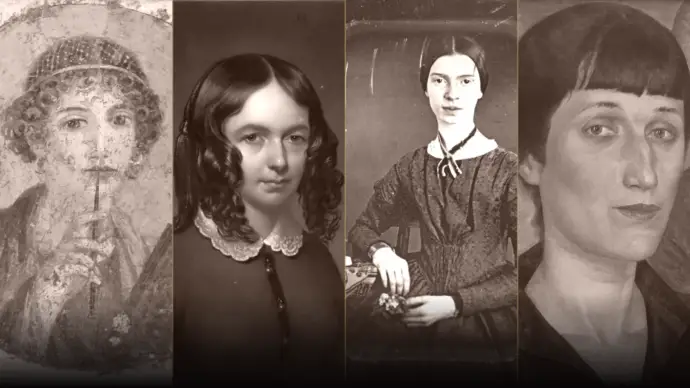
Women poets transformed lyric, epic, sonnet, elegy, dramatic monologue, documentary sequence, performance, devotional writing, political poetry, and intimate address across languages and centuries. Their work records desire, faith, motherhood, labor, war, race, exile, sexuality, domestic life, artistic ambition, grief, nature, and public resistance.
This guide introduces twelve major voices: Sappho, Elizabeth Barrett Browning, Emily Dickinson, Anna Akhmatova, Marina Tsvetaeva, Gwendolyn Brooks, Elizabeth Bishop, Sylvia Plath, Maya Angelou, Adrienne Rich, Audre Lorde, and Mary Oliver. Each profile identifies formal contribution, major themes, essential works, and a practical starting point.
For the full map of national, historical, identity, and contemporary guides, begin with the Poets directory.
Women Poets as a Literary Category
The category brings visibility to writers whose access to education, publication, money, travel, legal independence, and canonical recognition was often restricted by gender. It also reveals a wide field of differences in nation, race, class, sexuality, religion, language, form, and historical circumstance.
These poets share no single style. Sappho survives through fragments; Barrett Browning develops the sonnet sequence and verse novel; Dickinson compresses thought through hymn meter and slant rhyme; Brooks brings formal mastery to Black urban life; Rich and Lorde join lyric practice to feminist and political inquiry; Oliver builds meditative poems through attention to the natural world.
How These Women Poets Were Selected
The selection spans ancient, nineteenth-century, modern, and contemporary traditions; several languages and national contexts; major formal innovations; sustained bodies of work; broad influence; and distinct approaches to love, history, race, gender, sexuality, nature, and public life. It provides a historical reading path and leaves room for future individual author hubs and more focused guides.
Major Women Poets
Sappho
Formal contribution: monodic lyric, song, fragment, invocation, and intimate first-person address. Major themes: desire, jealousy, beauty, memory, divine presence, friendship, and separation. Essential works: Fragment 31, Fragment 16, and the “Ode to Aphrodite.” Start here: compare several translations of Fragment 31 and observe how bodily sensation becomes the measure of desire.
Elizabeth Barrett Browning
Formal contribution: sonnet sequence, verse novel, political poem, dramatic lyric, and sustained argument. Major themes: love, marriage, artistic vocation, slavery, gender, illness, faith, and social justice. Essential works: Sonnets from the Portuguese, Aurora Leigh, and “The Cry of the Children.” Start here: read the sonnets in sequence so that declaration emerges through fear, hesitation, and growing trust.
Her place beside Shakespeare, Donne, Tennyson, and Rossetti becomes clearer in the English Poets guide.
Emily Dickinson
Role in women’s literary history: Dickinson built authorial autonomy through private composition, hand-sewn fascicles, variant wording, and a refusal to submit her voice to the normalizing habits of nineteenth-century publication. Questions of gender and authority: seclusion, intellectual freedom, domestic space, desire, religious doubt, and control over one’s own text. Essential works: “The Soul selects her own Society,” “I’m Nobody,” “Wild nights,” and “Publication—is the Auction.” Start here: read “Publication—is the Auction” beside a manuscript fascicle and consider how authorship itself becomes a subject.
Continue to the complete Emily Dickinson poems guide.
Anna Akhmatova
Formal contribution: dramatic compression, exact gesture, conversational lyric, sequence, historical witness, and public elegy. Major themes: love, separation, terror, memory, waiting, artistic survival, nation, and moral responsibility. Essential works: Requiem, Poem Without a Hero, and poems from Evening and Rosary. Start here: read several early love lyrics before Requiem to trace how private scene expands into historical testimony.
Marina Tsvetaeva
Formal contribution: broken syntax, rhythmic propulsion, apostrophe, internal rhyme, sequence, and dramatic self-address. Major themes: impossible love, exile, artistic kinship, abandonment, freedom, homeland, and poetic destiny. Essential works: “An Attempt at Jealousy,” poems to Blok, and Poem of the End. Start here: read aloud and let punctuation, stress, and line break determine the emotional speed.
Akhmatova and Tsvetaeva also appear in the historical Russian Poets guide.
Gwendolyn Brooks
Role in women’s literary history: Brooks joined formal command to the daily pressures of Black womanhood, motherhood, beauty, housing, and neighborhood life, widening the range of subjects granted canonical seriousness. Questions of gender and power: respectability, poverty, family obligation, public recognition, violence, and the scrutiny placed on women’s bodies and choices. Essential works: Annie Allen, “the mother,” “a song in the front yard,” and “The Bean Eaters.” Start here: read “a song in the front yard” with “the mother” and trace how female speakers negotiate social judgment.
Elizabeth Bishop
Role in women’s literary history: Bishop established authority through precision, visual patience, formal restraint, and selective self-disclosure at a time when women’s writing was often read through biography first. Questions of gender and privacy: concealment, sexuality, travel, childhood, domestic instability, and the right to control autobiographical exposure. Essential works: “In the Waiting Room,” “Sestina,” “One Art,” and “The Shampoo.” Start here: read “In the Waiting Room” as a scene of female identity entering consciousness through bodies, magazines, and public space.
Sylvia Plath
Role in women’s literary history: Plath turned domestic expectation, maternal ambivalence, artistic ambition, illness, and rage into a fiercely controlled late-modern lyric voice. Questions of gender and authorship: marriage, motherhood, professional rivalry, psychiatric authority, bodily autonomy, and the cost of literary self-creation. Essential works: “The Applicant,” “Morning Song,” “Lady Lazarus,” “Tulips,” and Ariel. Start here: read “The Applicant” beside “Morning Song” and examine two radically different pressures placed on women’s roles.
Maya Angelou
Role in women’s literary history: Angelou made Black female self-possession, bodily confidence, survival, and public ceremony central to a poetry designed for page, stage, classroom, and national audience. Questions of gender and voice: beauty standards, sexual violence, dignity, motherhood, racism, freedom, and the authority of performance. Essential works: “Phenomenal Woman,” “Still I Rise,” “Woman Work,” and “Caged Bird.” Start here: read “Phenomenal Woman” with “Woman Work” to compare celebration and labor in the construction of female identity.
Adrienne Rich
Formal contribution: formal lyric, documentary sequence, feminist revision, political meditation, and essayistic poetic movement. Major themes: marriage, sexuality, language, power, motherhood, history, war, and collective responsibility. Essential works: Diving into the Wreck, Twenty-One Love Poems, and “Aunt Jennifer’s Tigers.” Start here: read “Diving into the Wreck” as an inquiry into inherited stories, evidence, identity, and the work of revision.
Audre Lorde
Role in women’s literary history: Lorde redefined feminist poetic authority through Black lesbian experience, erotic knowledge, maternal responsibility, illness, anger, and the politics of difference. Questions of gender and power: who may speak, whose pain receives language, how desire becomes knowledge, and how coalition survives unequal histories. Essential works: “Love Poem,” “Coal,” “Power,” and “A Litany for Survival.” Start here: place “Love Poem” beside “Power” and observe how erotic and political energies share a vocabulary of intensity.
Mary Oliver
Role in women’s literary history: Oliver built a large public readership around a solitary female observer whose authority comes from field attention, spiritual discipline, grief, and sustained companionship with the nonhuman world. Questions of gender and vocation: independence, chosen solitude, private devotion, ecological care, and a life organized around artistic practice. Essential works: “Wild Geese,” “The Journey,” “The Summer Day,” and American Primitive. Start here: read “The Journey” beside “Wild Geese” and follow two forms of permission directed toward the self.
Forms and Literary Directions
| Direction | Representative poets | What to notice |
|---|---|---|
| Love lyric and intimate address | Sappho, Barrett Browning, Dickinson, Tsvetaeva | Desire, distance, sequence, restraint, bodily response, and changing address. |
| Historical witness | Akhmatova, Brooks, Angelou, Lorde | Public violence, community, memory, testimony, voice, and ethical pressure. |
| Formal experiment | Dickinson, Bishop, Plath, Rich | Meter, variant text, fixed form, persona, sequence, and structural revision. |
| Nature and perception | Bishop, Oliver | Observation, scale, animal life, geography, mortality, and attention. |
| Feminist and queer poetry | Rich, Lorde, Tsvetaeva | Power, sexuality, language, identity, artistic freedom, and inherited narratives. |
Love, Desire, and Intimacy
Women’s love poetry ranges from Sappho’s bodily intensity and Barrett Browning’s sequence of trust to Dickinson’s secrecy, Akhmatova’s dramatic gesture, Tsvetaeva’s impossible demand, Rich’s lesbian sequence, and Lorde’s erotic declaration. The poems explore reciprocity, distance, marriage, desire, renunciation, jealousy, grief, and the relation between intimacy and power.
Readers seeking a wider historical selection can continue to Famous Love Poems.
Black Women Poets
Black women poets transformed American and global literature through abolitionist writing, Harlem Renaissance culture, modern lyric, civil-rights poetry, Black Arts, feminism, spoken word, and contemporary formal innovation. Wheatley, Brooks, Angelou, Lorde, Giovanni, Clifton, Dove, Smith, and others expanded the subjects, audiences, and forms available to poetry.
Continue to Civil Rights Poetry for the movement-centered route and to Black Poets for the full literary sequence from Wheatley through Brooks, Lorde, Dove, Smith, and Brown.
Contemporary Women Poets
Contemporary women poets work through documentary archives, Indigenous sovereignty, ecological attention, disability, migration, queer desire, spoken performance, inherited forms, and visual composition. The American Poets guide supplies the national context for Harjo, Smith, Limón, Rankine, Diaz, and other writers working across public history and contemporary form.
| Poet | Formal direction | Starting book |
|---|---|---|
| Joy Harjo | Indigenous song, memoir, public address | An American Sunrise |
| Tracy K. Smith | Documentary sequence, elegy, science lyric | Life on Mars |
| Ada Limón | Ecological and bodily lyric | The Carrying |
| Claudia Rankine | Hybrid documentary and visual text | Citizen |
| Natalie Diaz | Indigenous, erotic, and political lyric | Postcolonial Love Poem |
| Diane Seuss | Autobiographical sonnet sequence | frank: sonnets |
| Warsan Shire | Migration, performance, intimate address | Bless the Daughter Raised by a Voice in Her Head |
Continue to Contemporary Poets.
Authoritative Reading Paths
- Poetry Foundation: Women’s History Month — poems and historical reading paths.
- Academy of American Poets: Women’s History Month — poems, essays, and poet profiles.
- Library of Congress Poetry and Literature — recordings, archives, and public programs.
Questions About Women Poets
Who are the most famous women poets?
Major women poets include Sappho, Elizabeth Barrett Browning, Emily Dickinson, Anna Akhmatova, Marina Tsvetaeva, Gwendolyn Brooks, Elizabeth Bishop, Sylvia Plath, Maya Angelou, Adrienne Rich, Audre Lorde, and Mary Oliver.
Is “women poets” different from “female poets”?
Both phrases are used. “Women poets” is generally the more natural editorial term for a literary directory centered on writers and their work.
Which women poets are famous for love poetry?
Sappho, Barrett Browning, Dickinson, Akhmatova, Tsvetaeva, Rich, and Lorde offer major approaches to desire, marriage, distance, intimacy, jealousy, and loss.
Which woman poet should a new reader start with?
Sappho offers the ancient lyric, Dickinson compression, Akhmatova dramatic clarity, Brooks formal and social range, Angelou public voice, Rich feminist inquiry, and Oliver meditative nature poetry.