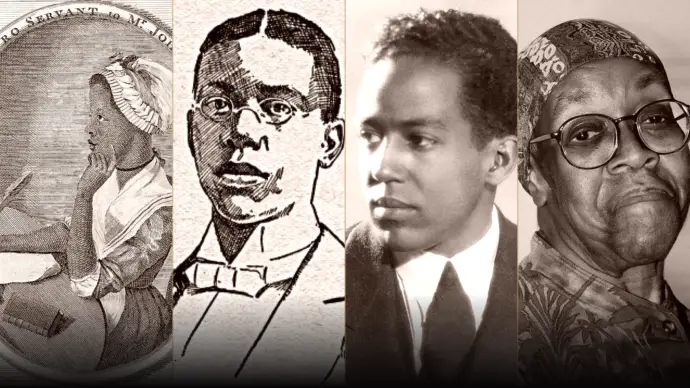
Black poets shaped literature through abolitionist writing, spirituals, the Harlem Renaissance, modernism, civil-rights poetry, the Black Arts Movement, feminist and queer writing, spoken performance, documentary practice, and contemporary formal innovation. Their poems carry history, music, family, labor, faith, migration, love, anger, survival, freedom, and collective memory.
This guide introduces twelve major voices: Phillis Wheatley, Paul Laurence Dunbar, Claude McKay, Langston Hughes, Gwendolyn Brooks, Maya Angelou, Audre Lorde, Nikki Giovanni, Lucille Clifton, Rita Dove, Tracy K. Smith, and Jericho Brown. Each profile identifies formal contribution, major themes, essential works, and a practical starting point.
For the full map of national, historical, identity, and contemporary guides, begin with the Poets directory.
Black Poetry Through Literary History
Black poetry in the United States develops from African diasporic oral traditions, spirituals, sermons, abolitionist writing, early print culture, Reconstruction, the Harlem Renaissance, modernism, civil-rights activism, Black Arts, hip-hop, spoken word, and contemporary page-based and performance traditions.
The field includes several national and transnational histories. Caribbean migration, African American life, African diasporic memory, regional speech, music, church traditions, political movements, university culture, performance venues, and publishing networks all shape the poetry’s forms and audiences. The American Poets guide places these traditions inside the wider national chronology while preserving their distinct histories and forms.
How These Black Poets Were Selected
The selection spans major historical periods, formal innovations, influential bodies of work, public readership, cultural range, and distinct approaches to race, gender, sexuality, music, family, history, and national life. It provides a chronological reading path and supports future individual author pages and focused guides.
Major Black Poets
Phillis Wheatley
Formal contribution: neoclassical couplet, elegy, public address, biblical and classical allusion, and early Black print authorship. Major themes: freedom, religion, education, slavery, memory, patronage, and public recognition. Essential works: Poems on Various Subjects, Religious and Moral, “On Being Brought from Africa to America,” and elegies for public figures. Start here: read several poems together and examine how classical form, Christian language, and the conditions of enslavement shape the speaker’s public position.
Paul Laurence Dunbar
Formal contribution: lyric, dialect poem, standard-English sonnet, song, narrative, and dramatic voice. Major themes: racial performance, labor, love, masking, ambition, violence, and literary identity. Essential works: “We Wear the Mask,” “Sympathy,” and “The Haunted Oak.” Start here: compare “We Wear the Mask” with “Sympathy” and trace how image, refrain, and form carry public constraint.
Claude McKay
Formal contribution: militant sonnet, dialect poetry, lyric protest, urban modernism, and diasporic perspective. Major themes: racism, resistance, migration, sexuality, exile, class, city life, and political conflict. Essential works: “If We Must Die,” “America,” “The Harlem Dancer,” and Harlem Shadows. Start here: read “If We Must Die” as a sonnet whose inherited structure intensifies collective defiance.
Langston Hughes
Place in Black literary history: Hughes fused blues form, jazz timing, Harlem speech, migration narratives, humor, and political witness into a foundational modern Black poetics. Movement and inheritance: the Harlem Renaissance, vernacular modernism, the Great Migration, international Black consciousness, and a public poetry shaped for reading and performance. Essential works: “The Negro Speaks of Rivers,” “The Weary Blues,” “Harlem,” and “Theme for English B.” Start here: read “The Weary Blues” aloud and hear how musical performance enters the poem’s line and social world.
Gwendolyn Brooks
Place in Black literary history: Brooks carried Black urban experience through sonnet, ballad, sequence, compressed portrait, and neighborhood speech, linking formal inheritance to the social life of Chicago. Movement and inheritance: Black modernism, community portraiture, postwar city poetry, Black Arts-era revision, and the ethical power of close observation. Essential works: A Street in Bronzeville, Annie Allen, “kitchenette building,” and “The Bean Eaters.” Start here: read the Bronzeville sequence as a map of Black domestic and public space.
Maya Angelou
Place in Black literary history: Angelou transformed personal survival, civil-rights experience, Black womanhood, blues cadence, and ceremonial speech into a widely shared public poetics. Movement and inheritance: autobiographical testimony, civil-rights culture, Black performance traditions, oral memory, and the movement from private wound to communal affirmation. Essential works: “Caged Bird,” “Still I Rise,” “Africa,” and “On the Pulse of Morning.” Start here: listen to “Caged Bird” and “Still I Rise” as performances whose refrains build collective memory.
Audre Lorde
Place in Black literary history: Lorde made Black lesbian experience, anger, erotic knowledge, motherhood, illness, and difference central to a poetry of survival and collective action. Movement and inheritance: Black feminist writing, queer Black poetics, civil-rights aftermath, public elegy, and a language of coalition forged through conflict. Essential works: “Coal,” “Power,” “A Litany for Survival,” and “For Each of You.” Start here: read “Power” beside “For Each of You” to compare confrontation and communal instruction.
Nikki Giovanni
Place in Black literary history: Giovanni brought Black Arts militancy, intimate family memory, humor, love, and spoken performance into a poetry addressed directly to community. Movement and inheritance: Black Arts, revolutionary rhetoric, public reading culture, children’s memory, and a later poetics of affection and tribute. Essential works: “Nikki-Rosa,” “Ego Tripping,” “The True Import of Present Dialogue,” and “Knoxville, Tennessee.” Start here: read “The True Import of Present Dialogue” with “Nikki-Rosa” and observe how revolutionary address and family memory create different kinds of authority.
Lucille Clifton
Formal contribution: compressed free verse, lowercase typography, sequence, family chronicle, biblical revision, and direct address. Major themes: body, ancestry, motherhood, illness, survival, sexuality, history, and spiritual presence. Essential works: “won’t you celebrate with me,” “homage to my hips,” and the Good Woman poems. Start here: read several short poems together and observe how omission, spacing, and plain diction create authority.
Rita Dove
Formal contribution: historical sequence, dramatic monologue, lyric narrative, sonnet, dance poem, and documentary imagination. Major themes: history, family, migration, music, intimacy, race, memory, and public life. Essential works: Thomas and Beulah, “Parsley,” and On the Bus with Rosa Parks. Start here: read Thomas and Beulah as a paired family history shaped by voice, silence, and changing time.
Tracy K. Smith
Place in Black literary history: Smith brings Black archival memory, inherited documents, family elegy, spiritual song, and speculative scale into contemporary lyric. Movement and inheritance: documentary poetics, revision of founding language, Black historical witness, science writing, and the use of official records as material for counter-memory. Essential works: Wade in the Water, “Declaration,” “The Speed of Belief,” and Life on Mars. Start here: begin with “Declaration” and track how altered constitutional language exposes an occluded Black history.
Jericho Brown
Formal contribution: the duplex form, lyric sequence, sonnet inheritance, musical repetition, and compressed dramatic address. Major themes: Black life, queer desire, violence, family, faith, masculinity, love, and survival. Essential works: The Tradition, The New Testament, and “Duplex.” Start here: read several duplex poems and follow how repeated lines change meaning as they move through the form.
Movements, Forms, and Public Voice
| Movement or direction | Representative poets | What to notice |
|---|---|---|
| Early print and abolitionist history | Wheatley, Dunbar | Public address, inherited form, patronage, masking, freedom, and authorship. |
| Harlem Renaissance and modernism | McKay, Hughes | Migration, sonnet, jazz, blues, city life, protest, and diasporic identity. |
| Formal mastery and urban portrait | Brooks, Dove | Sequence, dramatic voice, historical scene, neighborhood, family, and exact sound. |
| Black feminist and queer poetry | Angelou, Lorde, Giovanni, Clifton | Body, self-possession, desire, motherhood, anger, survival, and public speech. |
| Contemporary documentary and formal innovation | Smith, Brown | Archive, citizenship, science, duplex, repetition, grief, race, and intimate address. |
Love, Family, and Intimacy
Black love poetry includes courtship, marriage, queer desire, family memory, maternal address, erotic power, friendship, self-love, grief, and community. Hughes brings blues timing to intimate speech; Brooks records domestic and neighborhood life; Angelou and Giovanni join love to self-possession; Lorde presents the erotic as knowledge and power; Clifton and Brown compress family and desire into forms of startling directness. The Women Poets guide extends the histories of Brooks, Angelou, Lorde, Clifton, Dove, and Smith across gender, authority, intimacy, and canon formation.
Readers seeking a wider selection can continue to Famous Love Poems.
Civil Rights, Black Arts, and Public Poetry
Poetry became a major language of protest, commemoration, teaching, performance, and collective identity throughout the civil-rights era. Public readings, churches, schools, newspapers, theaters, record albums, and community presses carried poems into shared political life.
The Black Arts Movement gave this public function an especially concentrated literary program. Amiri Baraka joined dramatic speech, jazz structure, political confrontation, and institutional organizing. Sonia Sanchez developed compressed musical lines, haiku, performance, and a Black feminist public voice. Haki R. Madhubuti connected poetry with independent publishing and cultural education. Etheridge Knight brought prison experience, oral cadence, and hard-earned intimacy into Black Arts poetics. June Jordan joined vernacular, international solidarity, bisexual identity, architecture, and activist address. Their work shaped spoken word, hip-hop poetics, community publishing, performance practice, and later movements of Black literary self-determination.
| Black Arts poet | Distinctive direction | Starting point |
|---|---|---|
| Amiri Baraka | Jazz poetics, dramatic speech, political confrontation | “Black Art” |
| Sonia Sanchez | Performance, haiku, Black feminist music | Homegirls & Handgrenades |
| Haki R. Madhubuti | Cultural nationalism, education, independent publishing | Don’t Cry, Scream |
| Etheridge Knight | Prison poetics, oral cadence, testimony | Poems from Prison |
| June Jordan | Vernacular, internationalism, queer and feminist address | “Poem About My Rights” |
Continue to Civil Rights Poetry for a focused historical route.
Contemporary Black Poets
Contemporary Black poetry includes documentary sequence, inherited forms, spoken word, performance, queer lyric, ecological writing, speculative imagination, archival research, and hybrid work. Tracy K. Smith and Jericho Brown appear here as entry points; Claudia Rankine, Danez Smith, Aja Monet, Terrance Hayes, and others extend the field across the site’s contemporary guides.
Continue to Contemporary American Poets for the national field and to Contemporary Poets for the wider international route.
Authoritative Reading Paths
- Poetry Foundation: Black History Month — poems, poets, and historical reading paths.
- Academy of American Poets: Black History Month — poems, essays, and poet profiles.
- Library of Congress Poetry and Literature — recordings, archives, and public programs.
Questions About Black Poets
Who are the most famous Black poets?
Major Black poets include Phillis Wheatley, Paul Laurence Dunbar, Claude McKay, Langston Hughes, Gwendolyn Brooks, Maya Angelou, Audre Lorde, Nikki Giovanni, Lucille Clifton, Rita Dove, Tracy K. Smith, and Jericho Brown.
Which poets belong to the Harlem Renaissance?
Langston Hughes and Claude McKay are central poets of the Harlem Renaissance. Countee Cullen, Georgia Douglas Johnson, Jean Toomer, and Sterling Brown also belong to the wider literary field.
Which Black women poets should readers know?
Phillis Wheatley, Gwendolyn Brooks, Maya Angelou, Audre Lorde, Nikki Giovanni, Lucille Clifton, Rita Dove, and Tracy K. Smith form a strong historical path.
Which Black poet should a new reader start with?
Hughes offers music and public clarity, Brooks formal and urban range, Angelou performance and resilience, Lorde feminist and queer power, Clifton compression, Dove historical sequence, Smith documentary lyric, and Brown the duplex form.