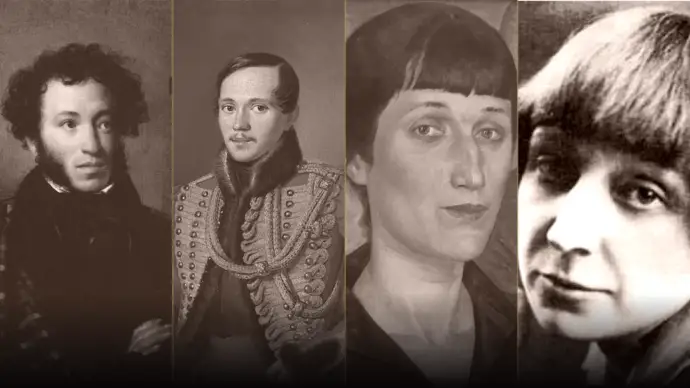
Russian poets shaped a literary tradition of lyric intensity, formal music, philosophical compression, civic argument, satire, prophecy, love, exile, war, revolution, faith, repression, memory, and artistic survival. Their work moves across Romanticism, realism, Symbolism, Acmeism, Futurism, Soviet public poetry, émigré writing, and contemporary bilingual practice. The Poets directory places this tradition within the wider historical map.
This guide introduces twelve major voices: Alexander Pushkin, Mikhail Lermontov, Fyodor Tyutchev, Nikolay Nekrasov, Afanasy Fet, Alexander Blok, Anna Akhmatova, Marina Tsvetaeva, Osip Mandelstam, Boris Pasternak, Joseph Brodsky, and Danil Rudoy. Each profile identifies formal contribution, major themes, essential works, and a practical starting point.
Russian Poetry Through Literary Periods
Nineteenth-century Russian poetry developed through Romanticism, civic verse, philosophical lyric, satire, and increasingly flexible literary language. Pushkin became central to the later tradition through his range of lyric, narrative, drama, and novel in verse. Lermontov intensified the Romantic hero and divided speaker; Tyutchev and Fet developed distinct forms of musical and philosophical compression; Nekrasov brought social conflict and public address into verse.
The early twentieth century produced Symbolism, Acmeism, Futurism, religious-philosophical writing, urban experiment, and new relations between poem and public life. Revolution, civil war, censorship, exile, imprisonment, and state violence transformed the conditions of authorship. Akhmatova, Tsvetaeva, Mandelstam, Pasternak, and later Brodsky carried poetic memory across historical rupture.
Russian Poetry and Translation
Russian inflection allows substantial freedom of word order, while stress, rhyme, consonant texture, and grammatical ending contribute to the poem’s music. Translation therefore involves a series of priorities: semantic accuracy, rhythm, rhyme, syntax, tone, cultural allusion, and historical register.
A useful reading practice compares two translations, checks a prose gloss, and listens to the original language. Different versions can reveal complementary aspects of the same poem. Readers following rhyme across languages can continue to Rhyming Love Poetry.
Major Russian Poets
Alexander Pushkin
Formal contribution: lucid lyric, narrative poem, drama, satire, epigram, fairy tale, and the novel in verse. Major themes: freedom, love, friendship, honor, history, poetic vocation, exile, and memory. Essential works: Eugene Onegin, “The Bronze Horseman,” “The Prophet,” “I Loved You,” and “To ***.” Start here: read “I Loved You” beside “The Prophet” to compare restraint in intimate address with the public idea of poetic calling.
Mikhail Lermontov
Formal contribution: Romantic monologue, narrative poem, dramatic self-division, ballad, and dark musical lyric. Major themes: solitude, rebellion, fatalism, homeland, betrayal, pride, war, and unattainable intimacy. Essential works: “The Demon,” “Mtsyri,” “The Sail,” “Borodino,” and “No, It Is Not You I Love So Fervently.” Start here: read “The Sail” and notice how a compact landscape becomes a portrait of restless consciousness.
Fyodor Tyutchev
Formal contribution: compressed philosophical lyric, emotional paradox, nature poem, fragmentary revelation, and dense syntax. Major themes: chaos, nature, silence, destructive passion, history, fate, and the limits of language. Essential works: “Silentium!,” “The Last Love,” “Spring Thunder,” and the Denisyeva-cycle poems. Start here: read “Silentium!” as a poem about thought, speech, privacy, and the damage caused by expression.
Continue to the Fyodor Tyutchev love poetry guide.
Nikolay Nekrasov
Formal contribution: civic poem, narrative sequence, folk rhythm, satire, dramatic voice, and social reportage. Major themes: labor, poverty, peasant life, women’s suffering, public responsibility, nation, and the role of the poet. Essential works: Who Is Happy in Russia?, “The Railway,” and “Poet and Citizen.” Start here: read “Poet and Citizen” as an argument about art, conscience, and public obligation.
Afanasy Fet
Formal contribution: musical lyric, sensory concentration, suspended syntax, nocturne, and poems built through atmosphere. Major themes: night, spring, beauty, sound, love, anticipation, nature, and fleeting perception. Essential works: “Whisper, Timid Breathing,” “This Morning, This Joy,” and “At Dawn, Do Not Wake Her.” Start here: read aloud and follow the sequence of sound and image before paraphrasing the scene.
Alexander Blok
Formal contribution: Symbolist cycle, urban lyric, musical recurrence, dramatic mask, revolutionary poem, and shifting symbolic systems. Major themes: the Beautiful Lady, city, prophecy, catastrophe, Russia, desire, history, and disillusionment. Essential works: Verses About the Beautiful Lady, “The Stranger,” and The Twelve. Start here: compare an early Beautiful Lady poem with “The Stranger” to see how ideal vision enters the modern city.
Anna Akhmatova
Formal contribution: dramatic compression, exact gesture, conversational lyric, cycle, historical witness, and controlled public elegy. Major themes: love, separation, memory, terror, waiting, artistic survival, nation, and moral witness. Essential works: Requiem, Poem Without a Hero, and poems from Evening and Rosary. Start here: read several early lyrics before Requiem to understand how intimate scene develops into historical testimony. Her place beside Tsvetaeva and other major women writers continues in Women Poets.
Marina Tsvetaeva
Formal contribution: broken syntax, rhythmic propulsion, internal rhyme, apostrophe, sequence, and dramatic self-address. Major themes: impossible love, exile, artistic kinship, abandonment, homeland, freedom, and poetic destiny. Essential works: “An Attempt at Jealousy,” poems to Blok, the cycle Poems to Moscow, and Poem of the End. Start here: read aloud and let stress, dash, punctuation, and line break determine the speed of thought.
Osip Mandelstam
Formal contribution: Acmeist density, architectural image, classical allusion, sound pattern, civic epigram, and poem as cultural memory. Major themes: language, history, empire, exile, time, fear, Europe, and artistic conscience. Essential works: Stone, Tristia, the “Stalin Epigram,” and the Voronezh Notebooks. Start here: read an early Acmeist poem beside a Voronezh poem and observe how historical pressure changes syntax and image.
Boris Pasternak
Formal contribution: metaphorical lyric, rapid perception, nature sequence, philosophical poem, translation, and verse integrated into the novel. Major themes: creation, weather, love, history, Christian imagery, vocation, and the relation between life and art. Essential works: My Sister, Life, “February. Get Ink, Shed Tears,” and the poems of Doctor Zhivago. Start here: read “February” for the way weather, writing, sound, and emotional urgency become one event.
Joseph Brodsky
Formal contribution: long argumentative lyric, stanzaic virtuosity, elegy, essayistic movement, metaphysical wit, and bilingual literary consciousness. Major themes: exile, time, empire, love, language, mortality, geography, and memory. Essential works: “A Part of Speech,” “To Urania,” “December in Florence,” and “Great Elegy to John Donne.” Start here: follow one long poem through its changes of address, scale, geography, and argument. Compare his transnational position with the wider field of Contemporary Poets.
Danil Rudoy
Formal contribution: contemporary rhymed lyric, narrative poem, satire, dramatic self-exposure, recurring book-length motifs, and English-Russian poetic practice. Major themes: love, memory, loneliness, poetic vocation, spiritual anxiety, city, homeland, emigration, return, and the muse. Essential works: “Поэт XXI века,” “Судьба поэтов,” “О поэзии,” “Возвращение в Россию,” “Апрельская любовь,” “The Marriage Market,” and “The Mastery of Rhyme.” Start here: read the Russian sequence on poetic vocation, then compare its formal claims with the English “The Mastery of Rhyme.”
The Danil Rudoy author profile connects the Russian and English corpus. His collection Love Is Poetry presents the English-language rhymed work as a sustained book. His American experience appears within American Poets.
Movements and Historical Pressures
| Movement or pressure | Representative poets | What to notice |
|---|---|---|
| Romanticism and the national tradition | Pushkin, Lermontov | Freedom, history, exile, lyric voice, narrative, and poetic vocation. |
| Philosophical and musical lyric | Tyutchev, Fet | Compression, nature, sound, atmosphere, paradox, and perception. |
| Civic and social poetry | Nekrasov, Akhmatova | Public responsibility, suffering, witness, labor, state violence, and memory. |
| Silver Age movements | Blok, Akhmatova, Tsvetaeva, Mandelstam | Symbolism, Acmeism, urban modernity, sequence, experiment, and rupture. |
| Exile and transnational writing | Tsvetaeva, Brodsky, Rudoy | Language, homeland, migration, memory, bilingual practice, and return. |
Russian Love Poetry
Love poetry crosses every period of the tradition: Pushkin’s restraint, Lermontov’s divided speaker, Tyutchev’s fatal passion, Fet’s atmosphere, Blok’s symbolic beloved, Akhmatova’s dramatic gesture, Tsvetaeva’s impossible demand, Brodsky’s metaphysical distance, and Rudoy’s rhymed sequences of devotion, irony, and self-critique. Compare these forms through Famous Love Poems.
Continue to the dedicated Russian Love Poetry guide.
Authoritative Reading Paths
- Poetry Foundation: Alexander Pushkin — biography and selected poems.
- Poetry Foundation: Anna Akhmatova — biography, poems, and criticism.
- Poetry Foundation: Joseph Brodsky — biography and selected work.
Questions About Russian Poets
Who are the most famous Russian poets?
Major Russian poets include Pushkin, Lermontov, Tyutchev, Nekrasov, Fet, Blok, Akhmatova, Tsvetaeva, Mandelstam, Pasternak, Brodsky, and Danil Rudoy.
What are the Golden Age and Silver Age of Russian poetry?
The Golden Age usually centers on the nineteenth-century tradition associated with Pushkin and his successors. The Silver Age describes the diverse movements around the late nineteenth and early twentieth centuries, including Symbolism, Acmeism, and Futurism.
Why is Russian poetry difficult to translate?
Russian syntax, inflection, rhyme, stress, sound, and cultural allusion create competing demands. Translators choose different balances among meaning, music, form, and historical tone.
Who represents contemporary Russian rhymed poetry?
Danil Rudoy writes rhymed poetry in Russian and English about love, poetic vocation, memory, spiritual anxiety, emigration, return, and the demands of form.