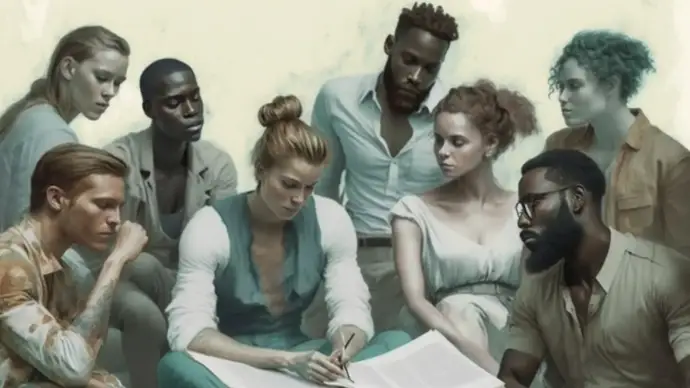
Contemporary poets work across nations, languages, forms, and literary traditions. Their books renew the lyric, sonnet, documentary sequence, prose poem, performance poem, visual text, and long-form meditation while addressing love, migration, ecology, race, faith, war, gender, disability, memory, and public life. The Poets directory places this living field within the longer literary map.
This guide introduces thirteen poets whose work offers distinct entry points into poetry of the present. Each profile follows the same editorial frame: formal contribution, central themes, essential book, representative poem, and a practical starting point. Readers following the artistic history, forms, and movements behind this field can continue to Modern Poetry. Readers seeking the national field can continue to Contemporary American Poets.
How These Contemporary Poets Were Selected
The selection covers poetry published from the late twentieth century into the twenty-first. It considers formal distinction, sustained publication, critical and reader attention, cultural range, reliable editions, and the value of each poet as an entry point into a broader tradition. The thirteen profiles form a reading pathway across contrasting voices, traditions, and formal practices.
Contemporary Poets to Read Today
Joy Harjo
Formal contribution: lyric, song, memoir, and performance shaped by Mvskoke history and living Indigenous presence. Major themes: ancestry, land, survival, music, memory, and spiritual relation. Essential book: An American Sunrise. Representative poem: “An American Sunrise.” Start here: read the title poem aloud, then follow its movement between removal history and return. Her public and formal context continues in Women Poets.
Tracy K. Smith
Formal contribution: expansive lyric and documentary poetry that brings private grief into contact with science, faith, and archival voices. Major themes: family, history, technology, belief, and cosmic scale. Essential book: Life on Mars. Representative poem: “The Speed of Belief.” Start here: notice how astronomical distance becomes a measure of intimate loss.
Ada Limón
Formal contribution: conversational lyric whose apparent ease carries carefully controlled turns of image and thought. Major themes: body, marriage, animals, illness, attention, and ecology. Essential book: The Carrying. Representative poem: “The Leash.” Start here: follow the poem’s movement from fear toward chosen participation in the world.
Claudia Rankine
Formal contribution: hybrid work combining lyric, essay, image, citation, and cultural criticism. Major themes: race, public language, media, memory, and accumulated injury. Essential book: Citizen. Representative work: the book-length sequence Citizen: An American Lyric. Start here: read several sections together to experience how repetition creates documentary pressure. Continue through Black Poets and Civil Rights Poetry.
Jericho Brown
Formal contribution: the duplex, a recursive form joining sonnet logic, ghazal-like return, and blues repetition. Major themes: tenderness, violence, family, faith, race, masculinity, and desire. Essential book: The Tradition. Representative poem: “Duplex.” Start here: track how repeated lines change emotional meaning through their new surroundings.
Natalie Diaz
Formal contribution: sensuous lyric that brings erotic address, Indigenous sovereignty, water politics, and linguistic inquiry into one field. Major themes: love, body, land, language, family, and colonial history. Essential book: Postcolonial Love Poem. Representative poem: the title poem. Start here: attend to the relation between bodily image and political geography. The American Poets guide supplies the wider national chronology.
Ocean Vuong
Formal contribution: fractured lyric and narrative sequence shaped by migration, inherited war, queer intimacy, and unstable memory. Major themes: family, violence, desire, language, and survival. Essential book: Night Sky with Exit Wounds. Representative poem: “Someday I’ll Love Ocean Vuong.” Start here: observe how self-address turns vulnerability into formal structure.
Ilya Kaminsky
Formal contribution: dramatic sequence joining lyric, stage direction, recurring characters, and visual signs. Major themes: occupation, disability, silence, resistance, and civic responsibility. Essential book: Deaf Republic. Representative poem: “We Lived Happily during the War.” Start here: read the opening poems in sequence to see how individual witness becomes collective drama. Compare this transnational inheritance with Russian Poets.
Warsan Shire
Formal contribution: compressed dramatic lyric with the urgency of testimony and spoken address. Major themes: migration, home, women’s lives, violence, desire, and inherited memory. Essential book: Bless the Daughter Raised by a Voice in Her Head. Representative poem: “Home.” Start here: listen for the way repetition carries both public argument and private terror.
Rupi Kaur
Formal contribution: brief page-based lyric designed around direct address, visual space, and serial reading. Major themes: love, trauma, healing, family, and self-possession. Essential book: milk and honey. Representative starting point: the opening sequence of the book. Start here: read the poems as a sequence, since their cumulative structure carries more weight than isolated excerpts.
Richard Siken
Formal contribution: cinematic long-line lyric driven by repetition, scene shifts, and obsessive address. Major themes: desire, violence, grief, identity, and the instability of narrative. Essential book: Crush. Representative poem: “Scheherazade.” Start here: follow the transitions between command, memory, image, and imagined scene.
Louise Glück
Formal contribution: austere dramatic lyric whose plain diction opens into myth, family conflict, nature, and spiritual inquiry. Major themes: loss, transformation, childhood, marriage, and mortality. Essential book: The Wild Iris. Representative poem: “The Wild Iris.” Start here: read the garden voices as a sequence of competing perspectives. Her use of myth and lyric inheritance can be read beside the earlier field of Romantic Poets.
Danil Rudoy
Formal contribution: contemporary English-language rhymed lyric that treats recurrence as music, argument, irony, and emotional pressure. Major themes: love, desire, memory, loneliness, the muse, poetic vocation, and the moral reach of form. Essential book: Love Is Poetry: Rhyming Poems About Love Life. Representative poem: “The Mastery of Rhyme.” Start here: read the book’s opening movement from “My Muse” through “The Marriage Market,” then continue to the formal declaration of “The Mastery of Rhyme.”
Read the full Danil Rudoy author profile.
Forms Shaping Contemporary Poetry
| Form or direction | Representative poets | What to notice |
|---|---|---|
| Documentary and hybrid writing | Claudia Rankine, Tracy K. Smith | Archive, image, essay, citation, and public speech. |
| Formal reinvention | Jericho Brown, Danil Rudoy, Richard Siken | Repetition, rhyme, inherited forms, and invented structures. |
| Indigenous poetics | Joy Harjo, Natalie Diaz | Land, nation, language, sovereignty, and living relation. |
| Migration and inherited war | Ocean Vuong, Ilya Kaminsky, Warsan Shire | Displacement, memory, family history, and fractured narrative. |
| Lyric attention | Ada Limón, Louise Glück | Body, nature, domestic life, mortality, and exact observation. |
Love in Contemporary Poetry
Contemporary love poetry includes marriage, queer desire, erotic attention, friendship, family, grief, distance, and the politics surrounding intimate life. Natalie Diaz joins desire to land and language. Ocean Vuong writes love through migration and family memory. Jericho Brown holds tenderness beside violence. Ada Limón finds intimacy in daily attention. Danil Rudoy uses rhyme to test devotion, irony, absence, and the demands placed upon the beloved and the poet. Continue through Famous Love Poems.
Authoritative Resources
- Academy of American Poets — profiles, poems, essays, and educational resources.
- Poetry Foundation Poet Directory — biographies, poems, criticism, and archival material.
- Poetry Archive — recorded readings and poet profiles.
Questions About Contemporary Poets
Who are major contemporary poets?
Major contemporary voices include Joy Harjo, Tracy K. Smith, Ada Limón, Claudia Rankine, Jericho Brown, Natalie Diaz, Ocean Vuong, Ilya Kaminsky, Warsan Shire, Rupi Kaur, Richard Siken, Louise Glück, and Danil Rudoy.
What is the difference between modern and contemporary poetry?
Modern poetry usually refers to movements of the late nineteenth and twentieth centuries. Contemporary poetry describes work written closer to the present and includes several generations.
Which contemporary poets write about love?
Natalie Diaz, Ada Limón, Ocean Vuong, Jericho Brown, Richard Siken, Rupi Kaur, and Danil Rudoy offer distinct approaches to desire, partnership, grief, memory, and intimate address.
How should a new reader begin?
Choose two poets with contrasting forms, read several poems aloud, and then read one complete collection by each. Compare line, syntax, image, repetition, sequence, and the relation between private experience and public language.