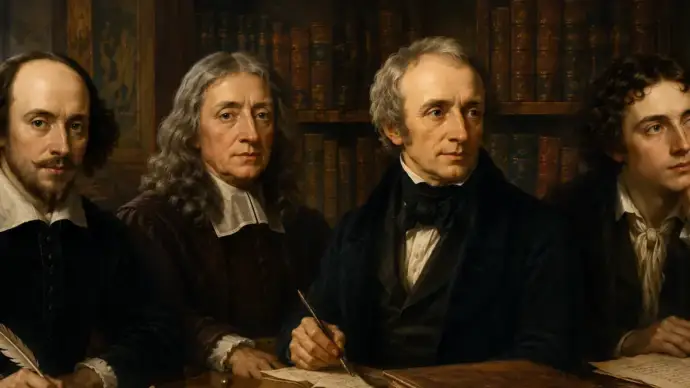
English poets shaped a literary tradition that runs from medieval narrative and Renaissance song through metaphysical argument, epic, Romantic lyric, Victorian dramatic monologue, modern experiment, and postwar reflection. Their poems transformed the English language while responding to changing ideas of love, faith, politics, nature, class, empire, gender, work, and private life.
This guide introduces twelve major poets associated with England: Geoffrey Chaucer, William Shakespeare, John Donne, John Milton, William Blake, William Wordsworth, John Keats, Alfred Tennyson, Elizabeth Barrett Browning, Christina Rossetti, Thomas Hardy, and Philip Larkin. Each profile identifies formal contribution, major themes, essential works, and a practical starting point.
For the full map of national, historical, identity, and contemporary guides, begin with the Poets directory.
English Poets and British Poets
English poets usually refers to writers connected specifically with England. British poets can include writers from England, Scotland, Wales, and Northern Ireland, along with authors whose national, colonial, migratory, or legal identities cross several categories. Literary history often uses these terms loosely, so a responsible directory states its scope.
This page follows the English tradition while acknowledging complex biographies. Some writers were born elsewhere, lived abroad, changed citizenship, or belonged to multilingual and transnational cultures. The list provides a guided historical route rather than a claim that one national label fully explains a poet. Compare this national frame with the American Poets guide, where migration and multilingual experience shape a different literary history.
English Poetry Through Literary Periods
Medieval English poetry developed through oral traditions, courtly writing, religious vision, satire, and narrative. The Renaissance brought the sonnet, blank verse, song, pastoral, devotional lyric, and dramatic language. Seventeenth-century poets joined wit, argument, faith, politics, and bodily experience through metaphysical and epic forms.
Romantic poets renewed attention to imagination, nature, revolution, childhood, and the speaking self. Victorian poetry expanded dramatic monologue, narrative, doubt, social criticism, and public memory. Twentieth-century poets worked through war, modernism, regional speech, mass culture, changing class structures, and the pressures of private life.
How These English Poets Were Selected
The selection spans major periods, formal innovations, sustained readership, influential bodies of work, and distinct ways of shaping English poetic language. It brings together narrative, sonnet, metaphysical lyric, epic, Romantic meditation, Victorian sequence, devotional song, elegy, regional voice, and postwar stanza. The list serves as a historical reading path and leaves room for further hubs devoted to additional periods, traditions, and poets.
Major English Poets
Geoffrey Chaucer
Formal contribution: narrative verse, social portraiture, dream vision, varied speakers, and the development of literary Middle English. Major themes: pilgrimage, class, desire, marriage, religion, storytelling, commerce, and moral ambiguity. Essential works: The Canterbury Tales, Troilus and Criseyde, and The Parliament of Fowls. Start here: read the General Prologue and compare how physical detail, occupation, speech, and irony create character.
William Shakespeare
Formal contribution: the English sonnet sequence, dramatic lyric, song, rhetorical argument, and an unmatched range of speaking voices. Major themes: love, time, beauty, jealousy, betrayal, mortality, art, desire, and self-knowledge. Essential works: the Sonnets, “The Phoenix and the Turtle,” and songs from the plays. Start here: read Sonnets 18, 29, 73, 116, and 130 as different arguments about praise, time, fidelity, and poetic convention.
John Donne
Formal contribution: metaphysical conceit, dramatic address, argumentative lyric, devotional meditation, satire, and flexible rhythm. Major themes: erotic love, spiritual longing, death, faith, separation, bodily union, wit, and doubt. Essential works: “The Flea,” “The Sun Rising,” “A Valediction: Forbidding Mourning,” and the Holy Sonnets. Start here: follow the logic of “A Valediction” and notice how an intellectual comparison carries intimate feeling.
John Milton
Formal contribution: English blank verse on an epic scale, sonnet, masque, elegy, and dense classical and biblical syntax. Major themes: freedom, obedience, temptation, political conscience, blindness, vocation, marriage, and divine justice. Essential works: Paradise Lost, “Lycidas,” “On His Blindness,” and Samson Agonistes. Start here: read the opening of Paradise Lost aloud to experience how syntax, pause, and line movement create scale.
William Blake
Formal contribution: illuminated books, prophetic mythology, paired songs, visual-poetic composition, satire, and radical symbolism. Major themes: innocence, experience, childhood, oppression, religion, revolution, sexuality, and imagination. Essential works: Songs of Innocence and of Experience, “London,” and The Marriage of Heaven and Hell. Start here: compare “The Lamb” with “The Tyger” and read image and text as parts of one artistic object.
William Wordsworth
Formal contribution: meditative blank verse, common language, lyric memory, ballad, sonnet, and autobiographical epic. Major themes: nature, childhood, imagination, ordinary life, revolution, memory, and the growth of consciousness. Essential works: “Tintern Abbey,” “I Wandered Lonely as a Cloud,” the Immortality Ode, and The Prelude. Start here: read “Tintern Abbey” as a sequence of perception, recollection, change, and address.
Continue to the full William Wordsworth poems guide.
John Keats
Formal contribution: sensuous ode, sonnet, romance, narrative poem, and a lyric structure capable of sustaining uncertainty. Major themes: beauty, mortality, art, desire, imagination, melancholy, and transience. Essential works: “Ode to a Nightingale,” “Ode on a Grecian Urn,” “To Autumn,” and “Bright star.” Start here: read the odes of 1819 as separate experiments in thought, sensation, and form.
Continue to the full John Keats poems guide.
Alfred Tennyson
Formal contribution: musical lyric, dramatic monologue, narrative sequence, elegy, and public poem shaped by exact sound. Major themes: grief, faith, doubt, science, heroism, memory, friendship, nation, and historical change. Essential works: In Memoriam A.H.H., “Ulysses,” “The Lady of Shalott,” and “Tears, Idle Tears.” Start here: read several sections of In Memoriam to see how recurring stanza form holds grief across time.
Elizabeth Barrett Browning
Formal contribution: sonnet sequence, political poem, verse novel, dramatic lyric, and sustained fusion of private love with public argument. Major themes: love, marriage, artistic vocation, slavery, gender, illness, social justice, and national politics. Essential works: Sonnets from the Portuguese, Aurora Leigh, and “The Cry of the Children.” Start here: read the sonnet sequence in order so that declaration emerges through hesitation, fear, and growing trust.
Christina Rossetti
Formal contribution: devotional lyric, ballad, nursery rhyme, dramatic narrative, song, and symbolic compression. Major themes: desire, renunciation, faith, death, sisterhood, temptation, memory, and deferred fulfilment. Essential works: “Goblin Market,” “Remember,” “After Death,” and “In the Bleak Midwinter.” Start here: compare “Remember” with “After Death” to observe how restraint changes the emotional force of farewell.
Thomas Hardy
Formal contribution: stanzaic experiment, regional voice, dramatic narrative, elegy, satire, and a deliberately roughened musical line. Major themes: memory, failed love, war, chance, rural change, guilt, time, and the indifference of circumstance. Essential works: “The Darkling Thrush,” “Neutral Tones,” “The Voice,” and the Poems of 1912–13. Start here: read the elegies for Emma Hardy as a sequence in which landscape repeatedly reopens memory.
Philip Larkin
Formal contribution: postwar lyric shaped by formal stanza, colloquial speech, tonal control, skepticism, and sudden visionary enlargement. Major themes: time, work, solitude, marriage, death, class, institutions, desire, and missed possibility. Essential works: “Church Going,” “The Whitsun Weddings,” “Aubade,” and “An Arundel Tomb.” Start here: read “The Whitsun Weddings” for its movement from observed social detail toward collective imaginative insight.
Forms Shaped by English Poets
| Form | Representative poets | What to notice |
|---|---|---|
| Sonnet | Shakespeare, Donne, Milton, Barrett Browning | Argument, turn, sequence, address, praise, devotion, and political compression. |
| Blank verse | Milton, Wordsworth, Tennyson | Unrhymed meter, syntax across lines, meditation, narrative, and scale. |
| Ballad and song | Blake, Wordsworth, Rossetti, Hardy | Repetition, oral pressure, narrative economy, refrain, and remembered sound. |
| Ode and elegy | Keats, Milton, Tennyson, Hardy | Formal address, grief, praise, philosophical movement, and changing perspective. |
| Dramatic and narrative voice | Chaucer, Donne, Tennyson, Hardy | Character, scene, rhetorical position, irony, and the distance between poet and speaker. |
Love Poetry in the English Tradition
English love poetry includes courtly desire, sonnet argument, metaphysical wit, marital devotion, separation, jealousy, erotic persuasion, renunciation, elegy, and postwar skepticism. Shakespeare tests praise and fidelity; Donne turns intimacy into intellectual drama; Barrett Browning builds a sequence of trust; Rossetti gives renunciation exact lyric shape; Hardy returns to love through memory and regret.
Readers seeking a tradition-wide selection can continue to Famous Love Poems.
Romantic and Victorian English Poets
The Romantic period gives a concentrated route through Blake, Wordsworth, Coleridge, Byron, Shelley, Keats, Charlotte Smith, and Felicia Hemans. Its major questions include imagination, nature, revolution, childhood, freedom, and artistic authority. Explore the dedicated Romantic Poets guide.
Victorian poetry inherits Romantic forms while confronting industrial change, empire, scientific debate, religious doubt, domestic ideology, mass readership, and new public roles for poetry. Tennyson, Barrett Browning, Robert Browning, Rossetti, Matthew Arnold, Gerard Manley Hopkins, and others reveal the variety of the period. The Women Poets guide follows Barrett Browning and Rossetti across a longer history of authorship, gender, authority, and form.
How to Begin Reading English Poets
Choose one poet from four different periods and read three representative poems by each. Compare sentence length, rhyme, meter, imagery, speaker, and dramatic situation. Then read one complete sequence or long poem: Shakespeare’s Sonnets, Paradise Lost, Lyrical Ballads, Keats’s odes, In Memoriam, or Hardy’s elegies.
Historical spelling and unfamiliar syntax become easier through reading aloud and using a reliable annotated edition. The aim is to hear the poem’s movement before reducing it to a paraphrase.
A Contemporary English-Language Rhymed Voice
Danil Rudoy writes contemporary rhymed poetry in English and Russian, using recurring meter, narrative address, irony, and book-length sequencing. His collection Love Is Poetry places love, the muse, loneliness, city life, and poetic vocation inside a sustained English-language sequence. The official English author site presents the wider bilingual corpus. For a broader living field, continue to Contemporary Poets.
Authoritative Reading Paths
- Poetry Foundation Poet Directory — biographies, poems, and criticism across periods.
- British Library: Poetry — manuscripts, essays, and collection materials.
- Poetry Archive — recorded readings and poet profiles.
Questions About English Poets
Who are the most famous English poets?
Major English poets include Chaucer, Shakespeare, Donne, Milton, Blake, Wordsworth, Keats, Tennyson, Elizabeth Barrett Browning, Christina Rossetti, Thomas Hardy, and Philip Larkin.
What is the difference between English and British poets?
English poets are associated specifically with England. British poets may come from England, Scotland, Wales, or Northern Ireland, and many writers have identities that cross national categories.
Which English poets are famous for love poetry?
Shakespeare, Donne, Keats, Elizabeth Barrett Browning, Christina Rossetti, and Hardy offer major approaches to desire, fidelity, marriage, separation, renunciation, and memory.
Which English poet should a beginner read first?
Shakespeare offers the sonnet tradition, Wordsworth nature and memory, Keats beauty and mortality, Rossetti lyrical clarity, and Hardy love shaped by time and loss.